More Than Beautiful
Women under siege and the need for an nurturing, powerful masculinity

“You are more than beautiful,” he said, and he meant it.
All the aggrieved past, in the history of women and in her life, had honed her and worn away the sheath of the world. She was a desert bloom, weathering intense pressure and heat, and drinking up the monsoon rains.
She was not an object of adoration but a resplendent being radiating a depth that only suffering and grace transformed by love could bring.
Modern society and the men typical of her era had forced her into a kind of parthenogenesis, a self-birthing absent the energy of manhood turned cruel and confused.”
These words, this prose-poem, leaped to my mind after speaking with a female friend at a lunch in London. She was both protected and expressed by a mural of tattoos composed of sacred geometry and a dragonfly on her sternum (a symbol of transformation she told me).
Transformation indeed. Just a short time ago, in one intense week, I had attended my son’s graduation from high school, participated in an intensive couple of days of orientation at his new college with my ex-spouse and the mother of my son, and moved our home into storage.
The world is transforming. Men and women are transforming, groping for ways to be, as traditional roles and modern roles have fallen away. In this unsteady uncertainty, I could empathize deeply not only with the vulnerability that women must feel right now, but my own as well. No “red pill” ideology could unseat this care, and the clarion call it elicits in my own heart.
We must become born anew, both men and women, and we must help each other to do it.
I am now taking the summer to reground, work in nature, and research and write for my book, How To Be a Real Christian, a deep-dive exploration into God as Love, and what that may mean for theology, society, self, and relationship. For the summer, I am working part-time on an organic-in-practice farm in England called The Church Farm Ardeley, and the rest of the time I cultivate friendships, read, research, and write. This opportunity became available through an organization called WWOOF (World Wide Opportunities on Organic Farms) and its United Kingdom and USA member organizations.
I have been here for about two weeks, and the work is great (goat walking, horticulture, camping support, livestock, jack-of-all-trades handyman). The people are great too, salt-of-the-earth people working in unison and being themselves in a fairly laid back environment committed to education and connection. I feel truly blessed.
It is amid this blessing that I notice several women whom I have talked to recently have the same story from which they are trying to emerge— that of womanhood and feminine energy under siege. They do not have similar backgrounds, but their stories share remarkable congruencies— one is a fellow Greek colleague, friend, and counselor living in London, another is a London artist whose work I have supported, and the last is a recently-arrived volunteer on the Farm from northern England.
Their honesty and experiences have generated these insights, so they are in some strong sense co-originators of the ideas I express. I want to do justice to their contributions without violating their privacy. Therefore, I have decided to extend to each a sacred feminine name, founded in myth, and prototypical of their personalities and struggles.
The Greek counselor I will call Sophia, she is the goddess of spirit and heart wisdom. The second, the artist, I shall call Athena, for she reflects the goddess Athena’s emphasis on mind and practical wisdom. The third, the new-comer to the Farm, I will call Gaia, and much like Gaia, she seeks to trust her own body’s wisdom and the wisdom of the earth.
These goddess archetypes live in the women today— as energies meeting real conditions, not as New Age tropes
From an apt AI summary (Google Gemini):
Sophia is the archetype of agape (unconditional, divine love) and gnosis (direct, heart-centered spiritual knowing). She represents the “Wisdom of God”—a [universal], mystical, and cosmic truth. Rather than focusing on winning wars or building cities, Sophia is focused on the soul’s journey, inner awakening, and the hidden mechanics of the universe. [1, 2, 3, 4, 5] Sophia is entirely un-martial [and vulnerable]. In Gnostic myths, she undergoes a raw, deeply psychological journey: she falls from the spiritual realm into the material world due to her intense desire for knowledge, scatters her divine light into humanity, and must be redeemed. Her archetype is intimately linked to the suffering, incubation, and eventual ascension of the human soul.
Athena is the archetype of phronesis (practical wisdom). Her intelligence is active, sharp, and highly functional. She rules over concrete human affairs: legal justice, statecraft, mathematical architecture, military strategy, and everyday crafts like weaving. Her wisdom is a tool used to solve earthly problems and maintain order. [1, 2, 3] Athena wears heavy armor, carries a shield (the Aegis), and wields a spear. She is a virgin goddess who rarely shows vulnerability. Her archetype encourages boundary-setting, objective thinking, and defensive vigilance.
Gaia is the ultimate archetype of incubation, raw creation, and instinctive intelligence. She moves past the analytical intellect of Athena and the spiritual mysticism of Sophia, stepping directly into the realm of biological and terrestrial wisdom. Gaia’s wisdom is primal and foundational. As a primordial deity (a Protogenos), she existed before the laws of civilization (Athena) or the cosmic theology of the universe (Sophia) were even formed. Her wisdom is that of survival, biodiversity, and the balance of ecosystems. [1, 2, 3] Gaia restores balance through natural cycles. However, her healing can feel harsh to individual egos because she prioritizes the health of the whole ecosystem over any single species or ruler.
The Difference: Sophia is the spirit (transcendence), Athena is the head (logic), and Gaia is the gut and the body (instinctual reality). They form a trinity of Spirit-Heart (Sophia), Mind (Athena), and Body (Gaia),
Sophia— the journey of Spirit to World
Sophia, as the archetype of spiritual wisdom, faces a world which does not honor female spirit even in its supposedly spiritual institutions. I note this, reflected in my friend “Sophia’s” tattoos. She is expressing what the world, through its warped masculine domination refuses to hear. Sacred geometry, the dragonfly, on her sternum, is a prophecy of a time when the feminine will yet emerge to give the world life again, beyond its current weight of male-dominated technological and scientific arrogance.
Artificial so-called intelligence, cryogenic freezing, transhumanism, robotics are all seeking and revealing a kind of a male parthenogenesis, an attempt by certain insular men to make life by themselves through silicon means, and therefore surpass and outdo the female in the one thing she has over them— the creation of life through biological means.
This effort has never worked out well. Witness early Christian attempts to exclude the feminine, the Divine Mother, from the wholly male Trinity— the Father, Son, and Holy Spirit (the spirit generally seen as male throughout Christian theology as the assertive force that inseminates the worldly shell or matter). Witness early attempts, notably Aristotle’s to posit that the male “seed” (semen) contained all of the life and aspects needed to generate a baby, and that the female womb was just a receptacle.
We got a “muscular” Christianity, stripped of feminine care, that caused wars between “fellow” Christians, killing untold numbers, including former enemies, Lutheranism and Roman Catholicism teaming up to kill thousands of Anabaptists in the 1500’s for the “crime” of believing in adult baptism and refusing to go to war or hold civic office. After nearly 2,000 years we now know that men and women equally contribute the genetic makeup of the child with the woman actually gestating and giving birth as a continuation of that life process embedded in a spirit which both encompasses and mutually expresses the masculine and feminine.
It is under the weight of this monomaniacal, warped “male” urge to self-sufficiently create life and dominate the planet that we find death, not life, to be the looming practical reality. This is why I empathized and absorbed, as wisdom, what my real-life Greek Sophia is telling me about her life. She was so tired of being cast as a character for the use, assumption, and consumption of others, that she decided to get these tattoos arising up her neck. She admitted uncertainty in meeting me in real life because people can be quite different than on-screen. Meeting face-to-face is certainly more vulnerable, and the energetic interaction is more inescapable. Luckily it went well. I respected her intelligence and care. She offered brilliant insights along with support for what I was doing, including suggesting the inclusion of my opening prose-poem in How to Be a Real Christian, my current research and writing project.
I think we both enjoyed being “outed” as the positive rebels we are, in contrast to a death-cult, calling itself civilization, which reduces men and women to modern hunters (scammers, hustlers, plunderers) and gatherers (attention-mongers, social media influencers) rather than co-creators. It is time for the real feminine to emerge powerfully along the real masculine for that transformation to occur.
Long live the feminine and a masculinity that can nurture that feminine. Long live the dragonfly. May spiritual and practical transformation indeed ascend over the coming tumultuous years.
Athena— the journey of Mind to Heart.
The real-life artist, whom I shall call “Athena,” feels significantly entrapped by the negative programming of childhood family life and a past marriage that she admits went on way longer than it should have. She is a mixture of stunningly evocative visual art, ability to sensitively create, and a mind-driven practical wisdom of how to survive economically and emotionally. In her life story, I heard a theme: Wanting to create and do art for a living but finding these paths often disappearing, including the sudden, unexpected death of a well-known designer with whom she had worked.
Her real spiritual path is one of mind to heart, to trust herself at a deep level and to take good care of herself in the meantime. I became acquainted with her genius (and it is genius), when I purchased one of her paintings where she uses broad strokes of paint to elicit such suggestive detail that you perceive the painting as a richly detailed rendering. It reminds me of Japanese “one stroke” painting, particularly Hitofude-ryu (一筆龍), which literally translates to "dragon in a single stroke,” capturing the interlocking scales and flow of the dragon’s body in one well-executed paint stroke. This, I believe, is a metaphor for Athena— trust her genuine stroke, her original talent, even amid the uncertainty of the world. Let that carry her.
This real-life Athena was quite self-deprecating and modest in her attention to herself. Boldness was muted by conditioning aimed at limiting her power. Affirmation was a dream for another world. Even when I shared that I had been quite moved by not only her painting but the way she wrapped it with such care— internal cardboard, saran wrap, tape, external cardboard— she demurred and simply attributed it to protection against mishandling in the international shipment.
This scenario somewhat mirrored the mythological Athena whose mother, Metis, pregnant with Athena was swallowed by Zeus (mea culpa!) to prevent rivalry with his power. Yet Metis lived within Zeus, giving birth to Athena and forging weapons and armor, which caused such a headache for Zeus that he had another god split open his head, and out popped Athena, a fully adult woman, fully armored, fully wise.
From the text description of the aforementioned video:
Gaia and Uranus foretold that Metis would bear two children: A daughter equal to Zeus in strength and wisdom… And a son destined to overthrow his father. The prophecy struck Zeus at his deepest wound — the fear of losing his throne, just as Cronus had before him. And so, the king of the gods chose fear over love. Using deception, Zeus tricked Metis into transforming into smaller forms until she became a tiny fly. In a single irreversible act, he swallowed her whole — imprisoning her within his own body. He believed he had ended fate. But he had only internalized it. Inside Zeus, Metis did not disappear. She continued to think. To plan. To exist. And when the time came, her child did not emerge from the womb… She burst forth from Zeus’s skull. Athena carried her mother’s wisdom into the world — proof that intelligence cannot be destroyed, only transformed. Metis’ story is not one of battle. It is the story of suppressed wisdom. Of power fearing intellect. Of a woman erased from myth — yet foundational to it. She is the silent architect of Olympus. The mind the king of gods could not control… only contain.
Unlike the Zeus of myth, I take the opposite stance, because I see women and men, female and male, properly enhancing EACH OTHER’S power through mutual creation, where the talents and powers of both create something (much like birthing a child) which both requires and exceeds them! And this child OUGHT to exceed the parent. That’s the whole point— overflowing generation in love surpassing what once was, not rivalry and suppression for the purposes of petty power, to reinforce and perpetuate the past!
This also means that men and women should support and encourage each other to trust themselves more deeply, and to exceed themselves, confronting and transcending the negative conditioning and trauma so many of us experience at vulnerable points in our childhood.
Self-trust, self-care, creativity, and love— these are the “weapons” of an emerging Athena who travels from head to heart. It was with this understanding, that I encouraged the real-life artist, “Athena”, to take as much time to sleep as she can, to rest and relieve her nervous system and the constant vigilance which attends sensitive people in a callous world. I bade her to eat healthy, heartily, and well. Also challenged her to get a very big canvas and both trust and practice her “one stroke” talent on a grand scale rather than simply on an 8” x 10” piece of art paper.
Gaia— the journey of Body/Nature to Mind, Heart, and Spirit
Perhaps one of least appreciated and most consequential aspects of human existence, especially in modern and post-modern society, is the body. We now know that our experiences, including our traumas, are encoded in our very cells, indeed in our very DNA via epigenetics. We also know that to process trauma stored in our body requires somatic, i.e. direct bodily recognition, holding, and healing in order for physical, emotional, and mental injury to truly be addressed. Intellectual talk will NOT do it. Emotional regulation will not do it. And even spiritual exercises and meditations will act more as symptom relieving methods, rather than “root cause” healers and liberators if the body is not consciously addressed and caressed.
The body, in particular the female body, is simultaneously disparaged, idolized, and used in late capitalist culture. It is viewed primarily as a site to be harvested for profit. Weight loss, plastic surgery, vitamins meant to “enhance” bodies on one hand co-exist with junk food, drugs, multiple surgeries meant to simultaneously destroy and mend bodies back together. So too are Mother Nature and Mother Earth seen as sites of plunder rather than wonder. The feminine nature and the bodies of human females is analogously treated as sites of use, abuse, and extraction via unrefined or brutal masculine sexual prerogative, control over reproduction, and denial of support for child bearing and child rearing.
Female body and nature are put in a vice of contradiction: She is put on a pedestal and “protected” without feminine input or consent, or pilloried, scapegoated, and dragged through the mud for not being willing to go along in a game that was neither of her making nor to her benefit.
The new volunteer on the Farm which I have chosen to call “Gaia,” is a person who exhibits deliberation and patience much like the Gaia or Mother Earth of Greek myth, but also has the flame of righteous anger, by her own admission, when pushed too far— especially an unstoppable “mother bear” instinct when protecting herself or those she cares about. I gleaned this from our conversations on the merits of men wanting to be appreciated and on her experience channeling the anger of “Lilith” in her past growth.
I remarked to Gaia that at least good men are pretty simple in this way. They do endeavor to give and not simply to take. They also want to be appreciated in giving. This confers their giving with value and prevents the suspicion that they are simply be taken for granted or used. Gaia flipped the script on me. Appreciation for many men is having themselves praised as well as their work, often in ways that reflect their own intention and desire, rather than the woman’s actual need. She would actually need to have time to contemplate, and consider, and let the “good deeds” of men settle with her before offering appreciation. Good point.
Gaia also talked about channeling her inner Lilith as a force to be reckoned with in her own right and not simply an extension of male desire and decision. This is especially apt, given the revealing story of how Lilith came to be. Lilith has a 4,000 year history, first appearing as a class of demons in ancient Babylonia, before being portrayed as a wasteland demon in the Dead Sea Scrolls, and then a winged succubus in the Babylonian Talmud, and finally as the first wife of Adam (before Eve) in a medieval Judaic tract called The Alphabet of Ben Sira. Talmudic rabbis needed to explain and dismiss the inherent equality granted male and female in Genesis 1:
26Then God said, ‘Let us make humankind in our image, according to our likeness… ’ 27So God created humankind in his image, in the image of God he created them; male and female he created them. (NRSV)
Instead of this reckoning with this equality, these rabbis established the preferred, derivative account of Eve coming from Adam’s rib in Genesis 2 by fictionally (and conveniently) drawing in the “demon” Lilith as Adam’s first wife, a woman who (gasp!) insisted on equality, having been made from the same dust as Adam, and refusing to lie under Adam during sex. When Adam refused, Lilith flew out of the Garden of Eden, and this is why she developed into a feminist icon, representing the autonomy and sovereignty of women apart from male demand and domination.
Yet Eve herself was not destined to escape patriarchal domination and blame. Witness the demonization of Eve in Christianity as a willing temptress who was responsible for tainting all of humanity with sin. The letters of Paul that encourage women to “submit to their husbands” (followed in churches) but men to “submit to God” (not followed in churches). Even the Trinity is all-male: Father, Son, and Holy Spirit (though some claim the Spirit could be viewed as female). There is no primordial and supernal divine mother to go along with the heavenly father in orthodox Christianity.
Woman fare no better in other major religions. Witness the dictates of Islam that prescribe covering the female body for modesty but not the male body. Derived from The Quran, women’s inheritance shares and legal testimony can be given half the value of men. Witness the norms within Hinduism in which such practices as the “sati” (burning the alive wife once her husband has died), banishing women from temples during menstruation, and injunctions to be constantly under that protection of a male relative. Buddhism, too, taught that a woman must be reborn as a man to achieve full enlightenment, and Judaism has spent a putative 3,000 years effectively banning all women from any priestly, theological, or scholarly function. It is no surprise that their doctrine is among the most sexist. One of their major blessings in morning prayers (Birkhot HaShachar) is: “Blessed are You, Lord our God, King of the universe, who did not make me a woman.”
But this inequality cannot endure. It flies in the face of the co-creative equality necessary for the thriving and life of both male and female. Women are indeed reclaiming their very bodies, hearts, minds, and spirits in struggle, error, triumph, and hard-won peace. Hopefully this can be done with the patient and potent polarity of men who have done their own rebellion from programmed domination and desire.
A nurturing, powerful, co-creative masculine presence
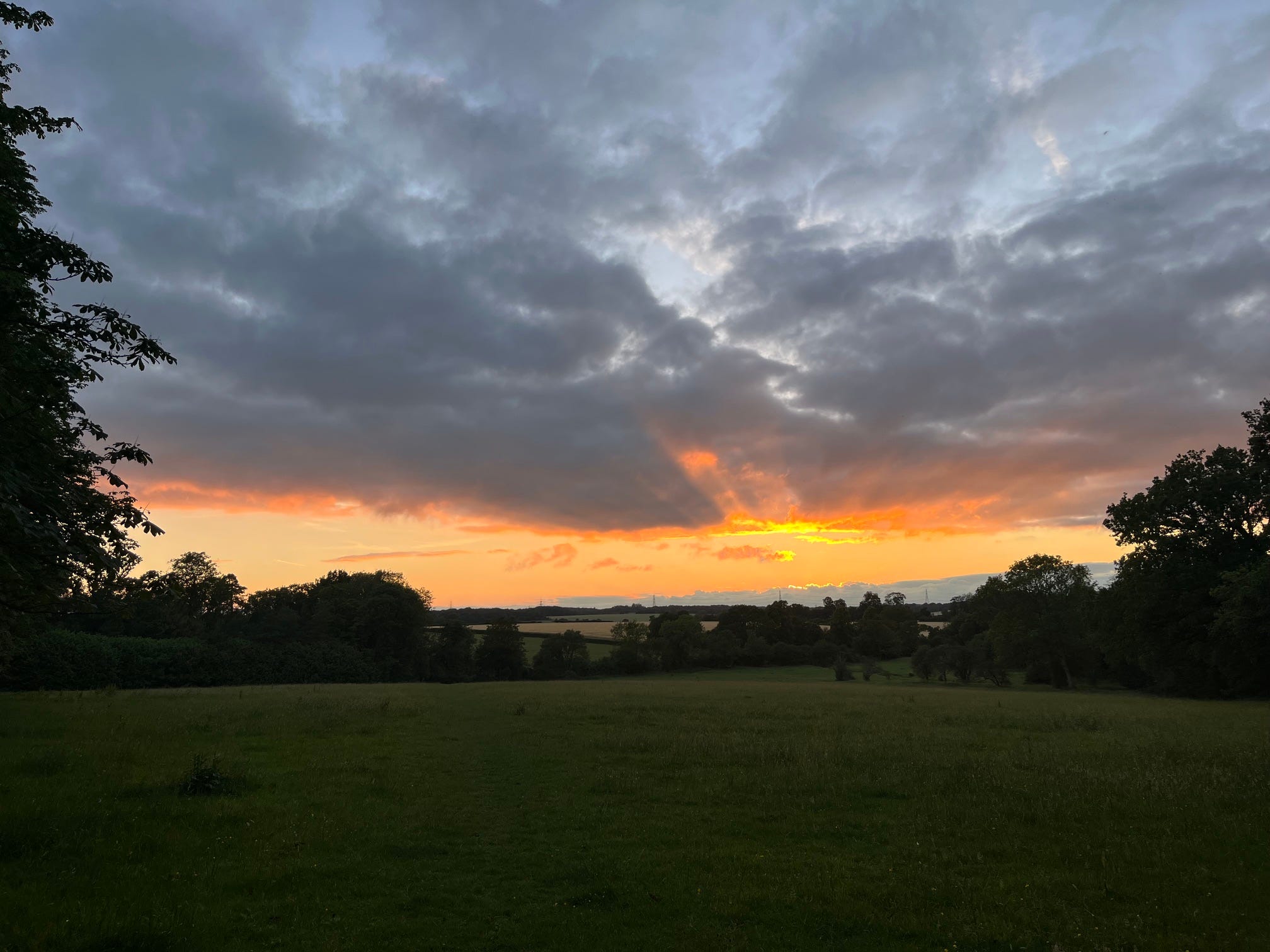
I was walking through the farm fields nearby with Gaia to enjoy a sunset with clouds rimmed with gold.
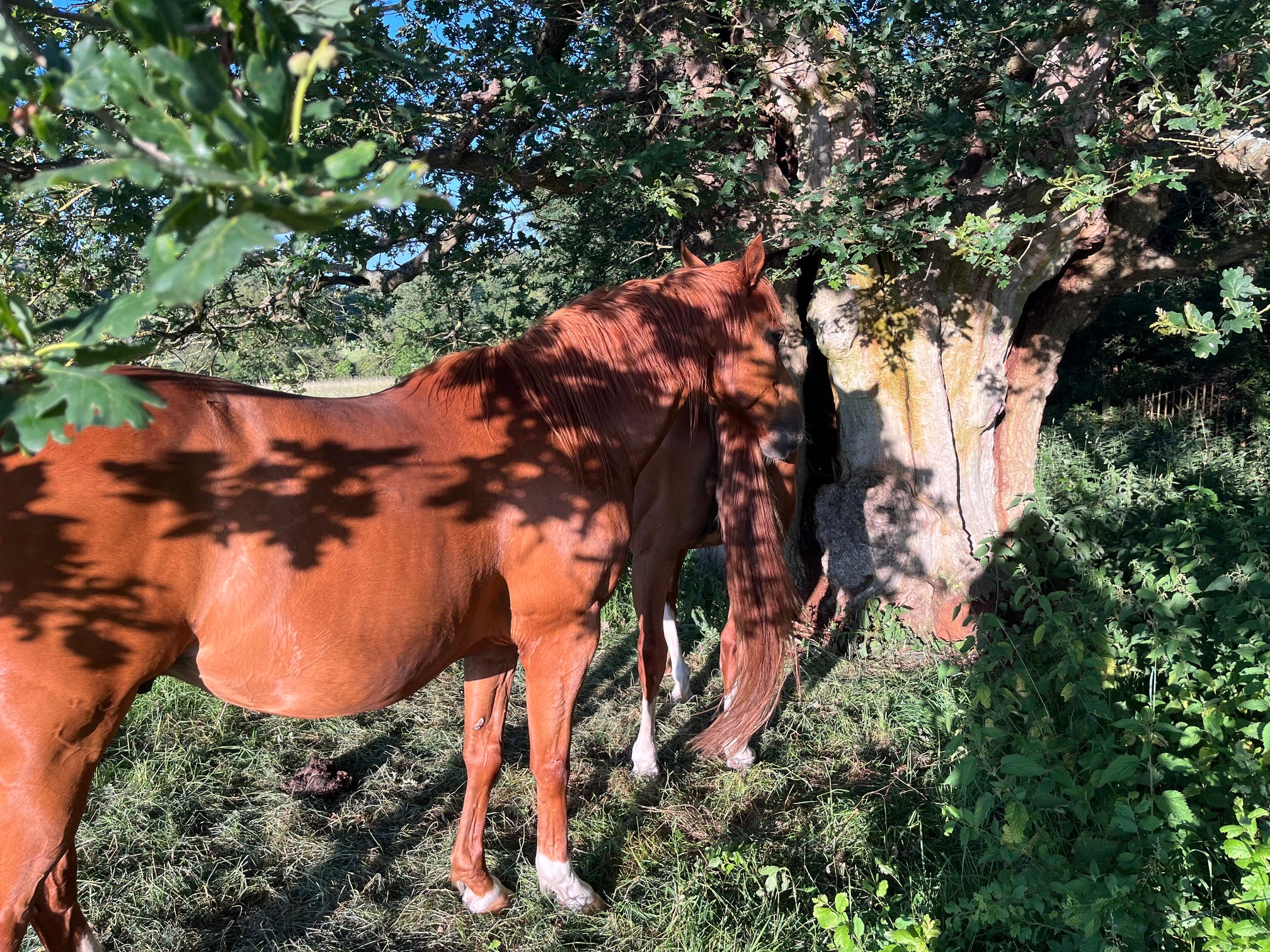
We came across two male horses that I had come to befriend by offering them some hand-picked grass. Though skittish at first, they had become accustomed to my kindness, and one allowed me to stroke his head and even give him a little kiss on his forehead and an affectionate hug. As I was walking, he tried to nibble my shoulder as if to establish dominance. I told him to cut it out and walked on.
It was in this instance, it occurred to me how many males, both male horses and human men, may view nurturing, intimacy, vulnerability, and affection as a sign of weakness or at the very best a sign of opportunity to demand more. A nurturing, powerful, co-creative masculinity “walks softly and carries a big heart (courage)” There is no need for dominance, but rather responsibility. There is no need for sycophantic praise, but rather respect. There is no need for fatuous gratitude, but rather mutual, creative, loving power.
Immature masculinity has historically fallen into two camps: 1) The desire to “protect” [i.e. make the world do what I want] through imposed control, warfare, and unilateral rule, or 2) the desire to abandon [flee the world, or create my own world in fantasy, because it won’t do what I want] through unresponsive “independence”, retreat, escape, and disappearance. In contrast to this, a mature masculinity both values and demonstrates the ability to nurture, which includes the capacity to patiently remain present, provide, listen, respond, and improvise without a pre-formed imperial mindset. Mature masculinity works with the world creatively “to see who I am and to find out what I want.
The first immature response emphasizes stoicism (stonewalling), negation, coercion discipline, and shutdown. The second immature response hews to rash emotionalism, i.e. reaction, gut impulse or instinct. The mature masculine response uses a deeper intuition and spiritual confidence to evince gladness, generosity. presence, and responsibility.
Yes, there is such a thing as male intuition a deep, unperturbed sensing and assurance that truly can hold the feminine—a knowing that “all is well”. It is spirit-centered. It empowers self and others. It’s voice and energy is not some avatar, function, formula or mask, but a spiritually confident thriving based in life. It has no tolerance for lies and false power. It finds ludicrous all attempts to mechanically master the world (and the feminine). It exists not in reaction ( as with incel culture) nor escape from alleged threats into a romanticized past (as with neo-traditionalism), but embraces the invitation to move forward and elevate.
These are the first lines about a book I authored and published eight years ago, called The Spiritually Confident Man: Pioneering a New Frontier of Co-Creative Masculinity:
For the first fifty years of my life, I was misplaced. In this half-century of time, I have experienced every condemning and promising form of manhood that I describe in this book. I have been a Toxic Man, a Striving Man, a Responsible Man, a Retreating Man, a Confused Man, an Equal Man, a Despairing Man, a Searching Man, and a Spiritually Confident Man.
On this journey, I have found that manhood, at its best, is a fundamentally creative endeavor. It is not about holding abstract ideas, following easy formulas, or kowtowing to cultural expectations. Vital manhood instead emanates and advances from the very spark of life given a man when he is born. Male personality is forged in aware engagement.
In the course of my life, I have experimented, tested, and failed with more versions of masculinity than I can count. I have accepted and left vocations both satisfying and unfulfilling. I have entered into romantic relationships that transformed what I thought a man should be. However, none of these adventures ever really defined me. I learned firsthand that there is no easy place for a man in today’s world. Male prerogative is slipping away, forcing men to re-create their own identities or else destroy themselves and those around them in resentments and resistance to change.
In this book I asserted that the man of the past, the reptile-brained Animal Man, the man of the present, the mammalian-brained Social Man, and the human-brained Co-Creative Man must learn to take the best of themselves (responsibility, equality, spiritual confidence) and work together. These must come together led by the co-creative man, not by some “hero’s journey” or Jungian archetype, but by real live character forged in a love that transcends the self and, yet at the same time, deepens into the most intimate reaches of the inner man.
What does this mean going forward?
I really don’t know what this means going forward. It means opening rather than closing. It means connecting rather than curling into a shell. It means asserting truth in the face of deception. It means loving, without enabling, in the face of fear. There is a defining age dawning. Can we drop all pretense and find out who we are and what we can be together. I hope so.
More than beautiful, indeed.
All blessings, Zeus
Thanks, Kim. It has been eye and heart opening.
It’s cool to hear snippets of your adventures on the farm, and of course, I love hearing your thoughts on topics related gender and human flourishing!